
A shift is happening in the world of learning—not loud, not cinematic, but quiet and unmistakable, like a tide withdrawing before the surface realizes the water has moved.
It’s happening in the background tabs you keep meaning to revisit.
In the PDFs piling up like geological layers.
In the YouTube lectures you “save for later” with solemn conviction.
In the notes app that holds fragments of a mind trying to grow faster than time allows.
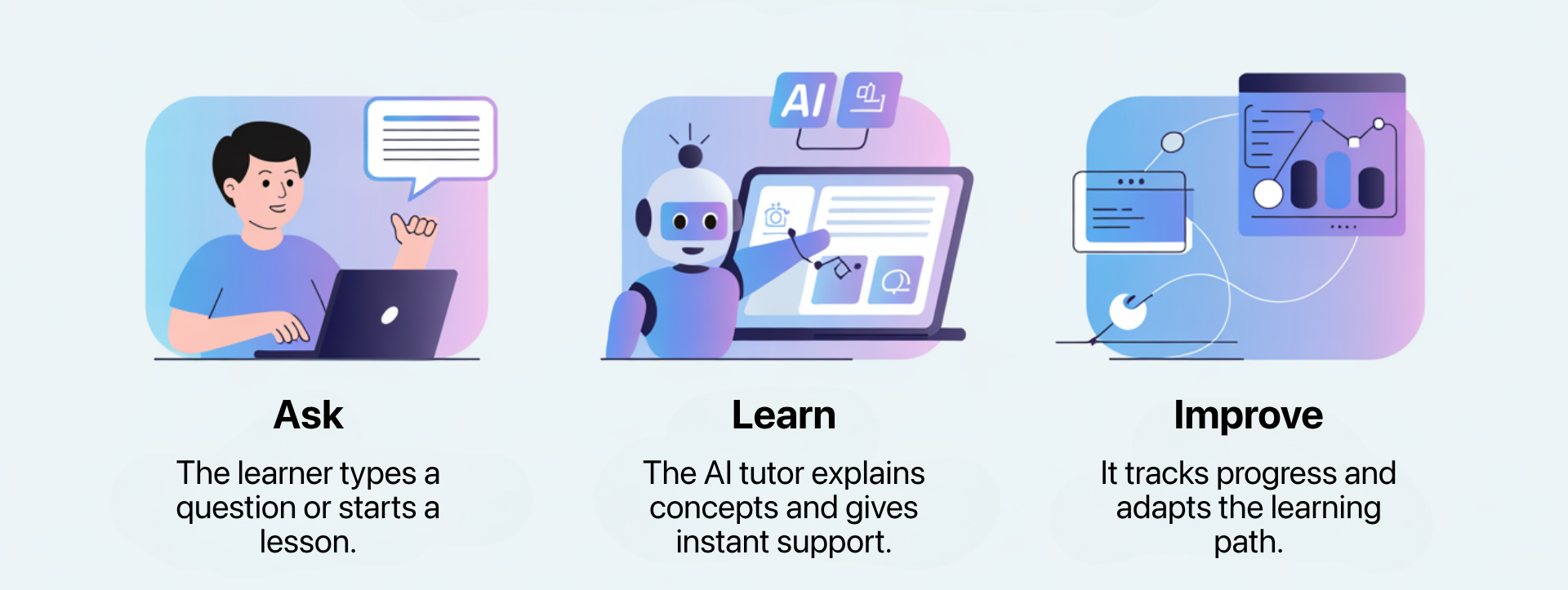
AI tutors are stepping into this mess—not to clean it up, but to help you see the structure hidden inside it.
And as they mature, they are revealing something subtle but profound: each tool carries a different belief about what learning is for.
Some are built for acceleration.
Some for survival.
Some for orientation.
Some for a kind of intellectual companionship that makes the act of learning feel human again.
For grad students and lifelong learners—two groups united by curiosity but separated by time—these differences matter. Because the tools you choose will influence not just what you learn, but how your thinking evolves.
Four platforms now define the landscape: NotebookLM, Mindgrasp, LRND, and YouLearn.
Each is a different kind of room in the same house.
Let’s walk through them—slowly, deliberately—as if we are exploring the architecture of a mind.

The Research Lab With Infinite Light
NotebookLM feels like walking into a research facility where the lights are always on and the assistant never gets tired.
You hand it a stack of readings—a semester’s worth of articles, a dissertation’s worth of citations—and it spreads them out like a cartographer mapping coastlines you didn’t know were connected. NotebookLM is brilliance without mood. It is clarity without hesitation. It handles complexity the way water fills a container: fully, instantly, with no visible strain.
It generates explanations that sound like a patient professor.
It synthesizes sources like a meticulous librarian.
It creates flashcards, quizzes, and audio overviews with the mechanical grace of a well-tuned instrument.
For grad students: NotebookLM is where you go when the reading list becomes planetary in scale.
For scholars: it’s a way to tame the jungle of literature reviews.
For thinkers: it’s a way to hear your sources talk to each other.
But NotebookLM is not intimate. It does not lean in. It does not ask who you are.
It is a fluorescent-lit lab that exists to process content at industrial scale.
Powerful, yes.
Personal, no.
The Calisthenics Coach for Your Brain
Mindgrasp feels like entering a training room.
Not the meditative kind—the kind with bright lights, clipped instructions, and the sense of a countdown clock always running somewhere in the background.
Upload anything—videos, lectures, readings—and Mindgrasp slices it into manageable segments: notes, summaries, flashcards, quizzes. It does not romanticize learning. It treats it as a craft of repetition, retention, and performance. Its tone is brisk. Its results, efficient.
If NotebookLM is a laboratory, Mindgrasp is a gym.
For grad students racing through impossible weekly workloads, Mindgrasp is the tool that keeps your head above water. It gives you the pieces you need to keep moving: the gist, the key points, the practice questions that let you go into an exam with a sense of coherence.
For lifelong learners, the value depends on whether you like structure.
Some people love a good drill.
Others resist it.
Mindgrasp doesn’t wander.
It doesn’t muse.
It doesn’t drift into interesting tangents.
It keeps you on the rails—and sometimes that’s exactly what you need.
A Library With a Pulse
Then there is LRND, which is not a lab or a gym but something softer: a library with warm lamps, perhaps a window cracked open, perhaps a notebook left on a wooden table where someone has been thinking for a while.
LRND doesn’t treat knowledge as something to consume quickly or compress aggressively. It treats knowledge as something to accumulate, slowly, deliberately, like sediment in a river that eventually shapes the landscape.
Everything you upload—papers, books, notes, voice memos, fleeting ideas—is preserved as part of a growing personal library. Your AI tutors don’t just answer from a single file; they answer from the whole of what you’ve been learning across time.
For grad students writing theses or researching across disciplines, LRND becomes a long-term intellectual companion.
For lifelong learners, it becomes a kind of cognitive home—a place where your ideas gather and mature.
And unlike the other platforms, LRND has a philosophy woven into it. It speaks openly about not outsourcing your mind, about the craft of understanding, about the ethics of slowness in a world obsessed with speed. It is a tool that feels like it cares—not in a sentimental way, but in the sense that it treats your learning as something worth protecting.
If NotebookLM is a lab and Mindgrasp is a gym, LRND is a study with a door you can close.
A place where thinking stretches out.
A place where your mind can hear itself again.

The Friendly Tutor at the Kitchen Table
YouLearn feels like the most casual of the four—not unserious, but relaxed. It doesn’t ask you to build notebooks or architectures. It doesn’t expect you to think in systems. It simply says: “What are you learning today? Let’s explore it together.”
Drop in a MOOC, a YouTube video, a PDF, a website—it adapts instantly. It gives you explanations, notes, quizzes, podcasts. It doesn’t judge your pace or your goals. It just meets your curiosity and gives it shape.
YouLearn is the kitchen-table tutor: approachable, flexible, unpretentious.
For grad students, it’s perfect for multimedia-heavy courses.
For lifelong learners, it’s a light companion for day-to-day exploration.
It’s not a long-term library.
It’s not a research engine.
It’s not an exam machine.
It’s a tutor—simple, warm, present.
Four Tools, Four Ways of Learning
Like any ecosystem, the differences matter:
-
- NotebookLM is the lab.
-
- Mindgrasp is the training room.
-
- LRND is the study.
-
- YouLearn is the kitchen table.
Each is a place where learning happens.
Each is a room built for a different mood, a different season of your mind.
What matters is not which one is the strongest, but which one resonates with the kind of learner you are becoming.
Recap
| Platform | Value Proposition | Best For | Core Personality |
| NotebookLM | A powerful AI research copilot for digesting and understanding large collections of readings. | Grad students tackling literature reviews, multi-source academic work, dense theoretical texts. | A bright, immaculate research lab with endless light. |
| Mindgrasp | A study engine that turns content into notes, summaries, flashcards, and quizzes. | Students with heavy workloads; exam-driven study; structured review. | A disciplined training room with a clear routine. |
| LRND.AI | A lifelong knowledge environment where your materials become a growing personal library. | Grad students on long-term research journeys; lifelong learners building durable knowledge; reading groups. | A quiet, warm study—where your ideas accumulate and take root. |
| YouLearn | A friendly AI tutor for PDFs, lectures, and videos. | Casual learners, MOOC explorers, multimedia learners. | A welcoming kitchen table tutor—easygoing, adaptive, encouraging. |
Learning is not a single act. It is an ecology. A rhythm. A landscape that shifts as you grow.Choose the tool that matches not just your workload, but your inner world.
Choose the one that supports the kind of mind you want to build.