

By someone who spends way too much time chatting with machines so you don’t have to.
If you’ve ever blamed ChatGPT for a mediocre answer, let me gently suggest: it’s not the AI, it’s the prompt.
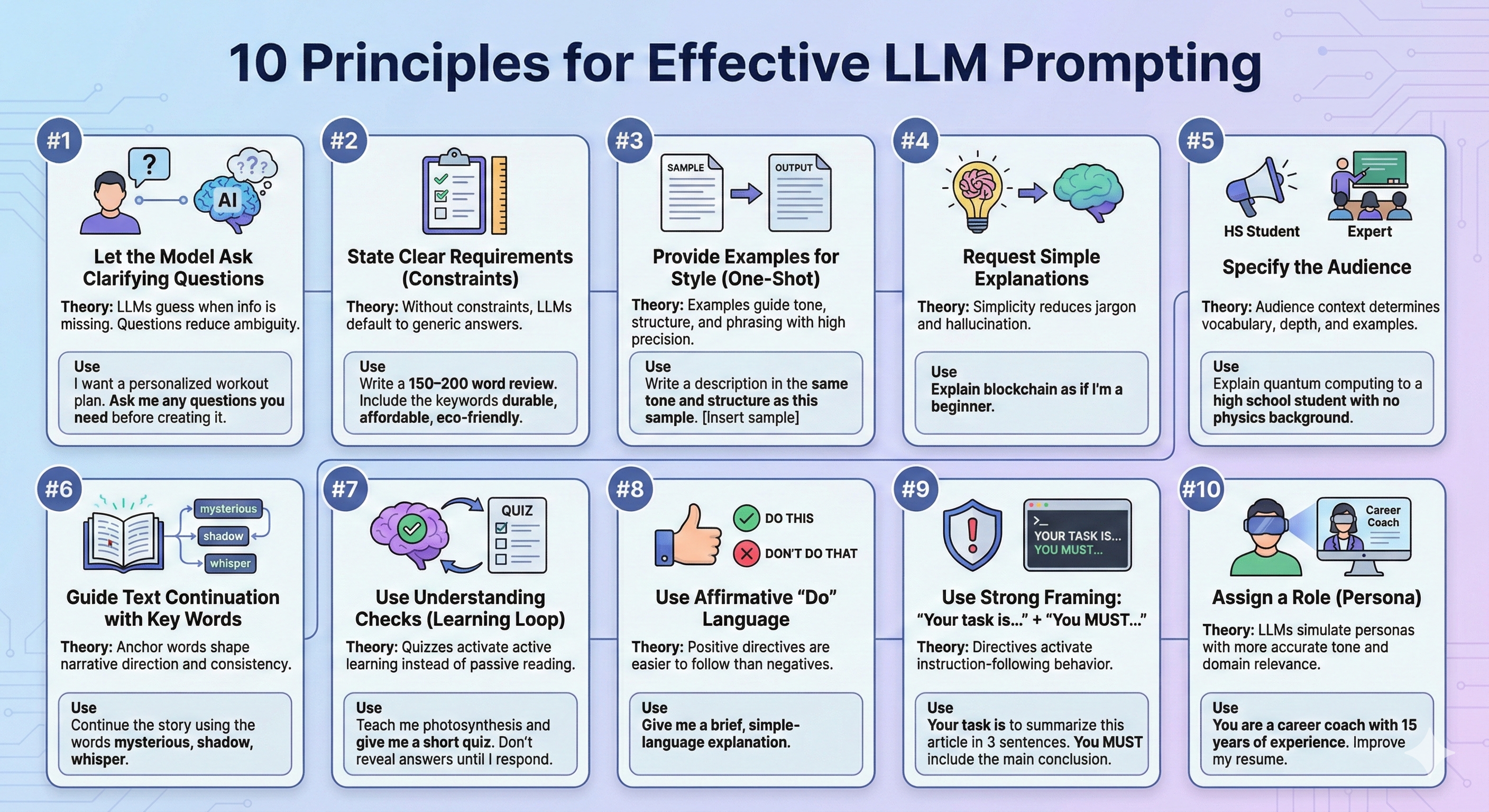
Yes, ChatGPT, Claude, Gemini, DeepSeek—these are all powerful tools. But they’re also glorified parrots with good taste: what you get out depends entirely on what you feed in. The real magic isn’t in the model, it’s in the prompting. And prompting, dear reader, is a skill. A learnable, craftable, level-up-your-brain kind of skill.
This is your friendly guide to becoming an elite prompt whisperer, no matter where you’re starting from. We’ll climb three levels of prompting mastery—Beginner, Intermediate, and Advanced—with real-world use cases, mental models, and templates you can steal shamelessly.
Let’s go.
🟢 Beginner: From “Talk to AI” to “Talk With AI”
Think of prompting as writing an email to a very eager intern with infinite stamina and zero context. Your job is to be clear, structured, and kind enough that they don’t rewrite your report as a limerick (unless you asked for it).
🎯 The 5-Step Prompting Framework (Mnemonic: C.R.A.F.T.)
Use this to build great prompts from day one:
Context – What background info does the AI need?
Example: “You are a UX designer helping me design an onboarding experience.”
Role – Assign a role to the AI to shape tone and focus.
Example: “Act as a product marketing manager for a SaaS startup.”
Action – What exactly should the AI do?
Example: “Write a persuasive email introducing our new analytics feature.”
Format – Tell it how to present the result.
Example: “Give me a subject line, email body, and CTA.”
Tone – Specify the mood or voice.
Example: “Keep it casual but professional, like Morning Brew.”
🛠 Prompt Template:
You are [ROLE]. Given the following context: [CONTEXT], please [ACTION]. Format the output as [FORMAT], and use a tone that is [TONE].
Use Case: Writing Help
Need help drafting a tricky client email or revising a dry blog intro? CRAFT it:
You are a writing coach. I’m working on a blog about user research. Please rewrite this paragraph to be more engaging. Format as a single paragraph, tone: friendly and thoughtful.
🟡 Intermediate: Getting Iterative, Not Frustrated
Once you’ve stopped treating the AI like a one-shot oracle and more like a creative collaborator, welcome to Level 2. Here’s where the real gold is: iteration.
🔁 The Iterate-Refine Loop
Think of your first prompt as a rough sketch. Your job now is to:
Critique the Output – What worked? What didn’t?
Clarify Your Intent – More examples? Better tone? Tighter scope?
Refine the Prompt – Add instructions based on step 2.
Ask for Variations – “Give me 3 takes,” “Make it spicier,” “Simplify for a 10-year-old.”
🛠 Prompt Add-Ons:
“Now make it shorter, snappier, and add a metaphor.”
“Give me three alternative subject lines with different emotional appeals.”
“Rewrite this in the style of Animalz.”
Use Case: Course Design
You’re an instructional designer. I’m building a short online course on behavior change. Help me structure a 3-part lesson. Use plain language. Then suggest engaging learning activities for each section.
(Refine until it feels like something you’d actually teach.)
🔴 Advanced: Prompting Like a Prodigy
Welcome to the deep end. This is where the nerdy fun begins—and where prompting becomes a genuine intellectual skill.
Let’s unpack four powerful techniques from the prompting dojo.
1. 🧠 Chain of Thought (CoT)
Ask the model to “think out loud.” It improves reasoning, planning, and analysis.
Prompt: Let’s solve this step by step. What’s the first thing we should consider?
Use Case: Learning Science
You are a learning theorist. Step by step, explain why retrieval practice is more effective than rereading for long-term retention.
2. 🌳 Tree of Thought (ToT)
Ask the AI to branch into multiple paths or strategies before choosing the best.
Prompt: Brainstorm three distinct ways to approach this problem. Evaluate each one’s pros and cons, then recommend the best option.
Use Case: UX Strategy
You’re a UX researcher. Brainstorm three ways to reduce cognitive load on our mobile checkout flow. Evaluate tradeoffs.
3. 🔗 Prompt Chaining
Link multiple prompts together, treating the output of one as the input to the next. Great for multi-step tasks.
Prompt Chain:
“Summarize this dense academic article in bullet points.”
“Now turn that summary into a 3-minute explainer script.”
“Rewrite the script for a high school audience.”
Use Case: EdTech Content Creation
4. 🧬 Meta Prompting
Ask the AI how to prompt itself better.
Prompt: How should I phrase a prompt to get you to act like an expert marketing strategist for a sustainability brand?
Weirdly powerful. It’s like teaching a genie to optimise your wishes.
🔄 Putting It All Together
Let’s say you’re a creator designing a lead magnet on “Habit Stacking.”
Beginner:
You’re a productivity writer. Write a one-page guide on habit stacking. Format with a headline, intro, and 3 actionable tips.
Intermediate:
That’s great! Now give me three title options. Make one punchy, one curiosity-driven, and one super practical.
Advanced:
Brainstorm three frameworks for habit stacking based on behavioural science. Evaluate each, and help me turn the best one into a 3-day email mini-course.
Boom. That’s the progression.
✍️ Final Thoughts: Prompting as a Creative Superpower
The models don’t matter as much as you think. Whether you’re using ChatGPT, Claude, Gemini, or DeepSeek, the game is the same: clear intent + smart prompting = magical results.
Prompting is not just a technical trick. It’s a thinking tool, a writing aid, a creative amplifier. When you get good at it, you stop feeling like you’re using AI—and start feeling like you’re collaborating with a brilliant, slightly alien co-pilot.
Learn to prompt well, and you don’t just get better AI answers. You get better ideas.
Make the first step and enjoy the journey!

- No limited trial period
- No upfront payment
- No automatic renewal
- No hidden costs