
I. The Disappearing Edges of Your Voice
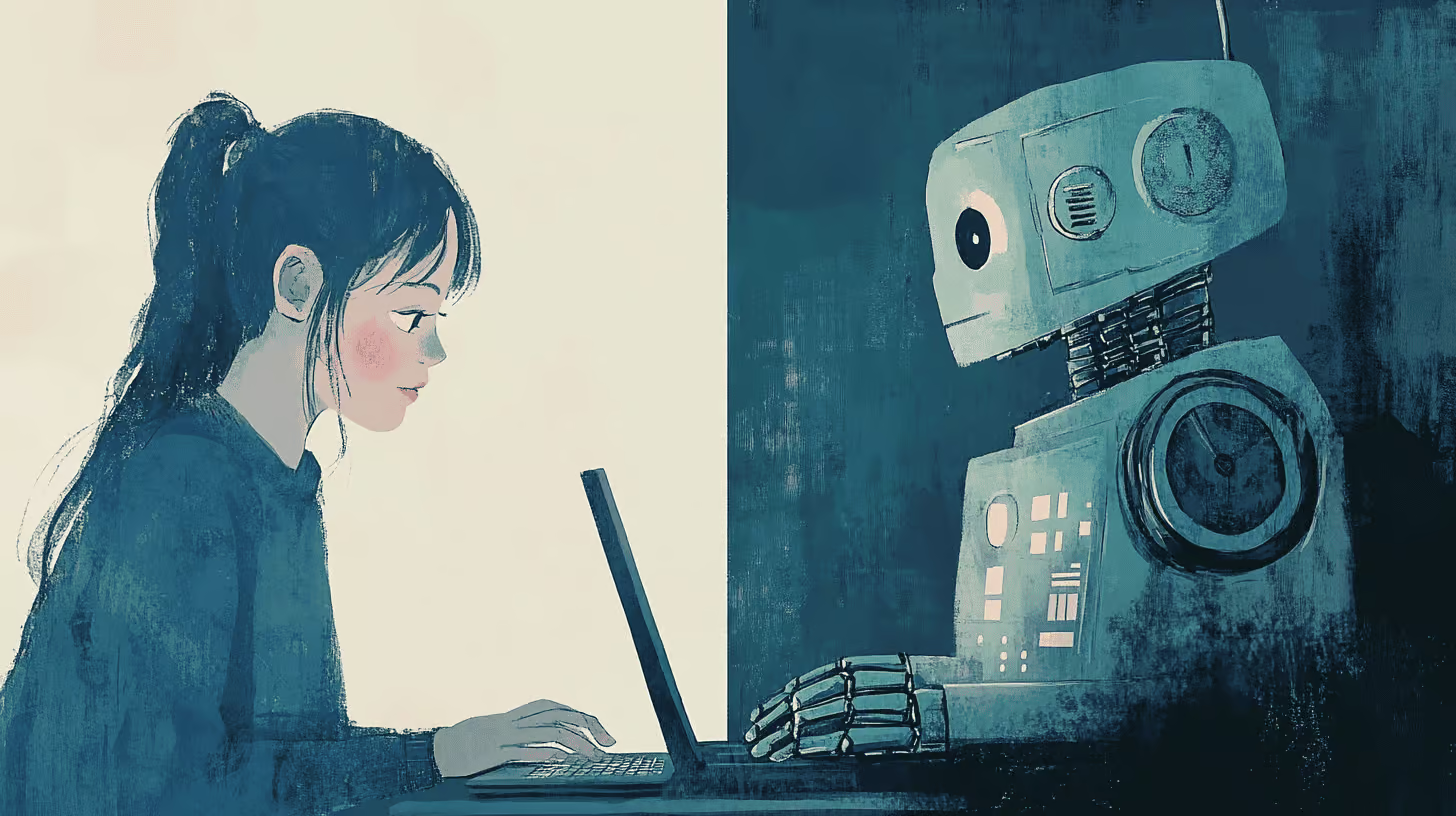
Something subtle is happening across laptops and writing apps around the world. People type a prompt into an AI model, watch the paragraphs appear, and feel a wave of admiration. The sentences are clean. The structure is elegant. The tone is neutral in a way that feels professional. It’s impressive—so impressive that many people accept the text almost immediately. The draft feels finished before their own thoughts have even started to warm up.
But beneath that smoothness lies a quieter emotion: a faint sense of distance, as if you’re reading a version of yourself written by someone who has studied you but never met you. The writing is not wrong—it’s simply not yours. Something about it lacks the crookedness of your internal rhythm, the particular tension of your personal cadence, the odd little metaphors your brain reaches for instinctively. It has no fingerprints.
This is the core danger of generative writing. It produces text that is so well-formed that it becomes easy to overlook the fact that your identity has been quietly edited out of the process. Writing used to be a mirror of your mind. Now, if you’re not careful, it becomes a mask you wear without noticing. The machine doesn’t steal your voice; it slowly erodes it through convenience. And convenience is seductive. It tempts you to let go of the difficult parts of writing—the messy drafting, the awkward thinking, the frustrating imprecision that eventually leads to clarity. These are the moments when your voice takes shape. Remove them, and what remains is technically correct but internally hollow.
Voice is not decoration. It is the residue of your thoughts moving through language. It carries your temperament, your history, your humor, your pace, your emotional temperature. It contains your habits of attention—what you linger on, what you cut away, what you cannot resist pointing out. AI, by design, gravitates toward the average. You, by nature, are not average. If you let generative text replace the difficult early stages of writing, your uniqueness begins to dissolve into universal intelligibility.
The quiet, polished neutrality of machine-written text is comforting, and that comfort is exactly why it’s dangerous. Something that arrives too perfect leaves no space for discovery. Writing is thinking, and if a machine does the first draft, then the machine does the first thinking. By the time you enter the process, the cognitive shape has already been decided. You inherit a direction you didn’t choose. You become an editor of someone else’s logic rather than an author of your own.
II. Editing as an Act of Self-Restoration
True editing is not the correction of mistakes. It is the reclamation of meaning. When AI hands you a draft, the temptation is to adjust a few phrases, tweak the tone slightly, replace a sentence or two—and then call it your own. But editing generative text requires a different kind of effort, almost the inverse of traditional revision. Instead of smoothing rough thinking, you reintroduce the texture that makes the writing alive.
This is where the work becomes personal. You begin to ask yourself whether the paragraphs reflect what you actually believe, not simply what sounds reasonable. You question whether the metaphors feel natural to you, whether the pace resembles your internal pacing, whether the transitions feel like something your mind would build. You start to bend the draft back toward yourself—adding warmth where the machine was cold, inserting a surprising turn where the machine was predictable, breaking a sentence deliberately because your own thoughts do not move in uniform lines.
In this way, editing becomes an act of identity. It forces you to reappear in the text. You inject the asymmetries the machine avoids, the idiosyncrasies it cannot guess, the personal histories it cannot feel. You restore the emotional undercurrent, the subtle insistence, the quiet defiance, the interior logic that emerges only when you write from lived experience.
AI can mimic tone, but it cannot know intention. It can generate relevance, but not resonance. It cannot sense the memory behind a metaphor or the risk embedded in a confession. It cannot feel the stakes of what you are trying to say. These layers must be written from within, not grafted on from outside.
Editing AI text therefore becomes a practice of returning to yourself. It requires slowing down, questioning, sharpening, undoing. It is in this slow, deliberate revision that your voice regains its presence. The generative draft becomes a starting point—a scaffold you reshape until it holds the emotional and intellectual weight of your own thinking.
If you skip this stage and publish what the machine gives you, you are not using AI to amplify your voice. You are allowing it to ventriloquize you. And the more you do it, the more your natural voice weakens from lack of use, like a muscle atrophying in the absence of resistance.
III. Preserving Humanity in a Hybrid Future
The future of writing will not be human-only nor machine-only. It will be hybrid. But hybridity is not neutrality. It’s a relationship in which you must remain the author even when you are not the typist. The danger is not that AI will replace your creativity. The danger is that you will unintentionally replace your own voice with a statistically pleasing imitation.
To resist that subtle loss, you have to stay inside the process. You begin a draft not by asking the machine to write for you, but by offering the spark yourself: a paragraph, a question, a half-formed thought. You let AI expand it, not originate it. You use the machine as a collaborator rather than a ghostwriter. You let it accelerate mechanics while you preserve meaning.
In this future, your job is not to outwrite the machine. Your job is to outfeel it, outinterpret it, outintend it. You hold the thread of lived experience, and that thread cannot be automated. You write from the inside; the machine writes from the outside. That distinction is your advantage. It means your flaws matter. Your hesitations matter. Your incomplete thoughts matter.
Voice emerges not from perfection but from presence.
From attention.
From emotional truth.
From the courage to sound like yourself even when perfection is one click away.
AI will get better. The writing it produces will become increasingly indistinguishable from human text. But your inner world—the way you perceive, the way you interpret, the way you insist on the meaning behind your words—will always remain beyond its reach. That is where your voice lives. That is what your writing must protect.
The generative era does not require that you abandon AI. It requires that you stay awake. When AI writes, you edit—but not as a passive fixer of grammar. You edit as a guardian of identity. You shape the draft until the words feel inhabited. You reclaim the edges the machine smoothed out. You ensure that your presence—not the algorithm’s neutrality—is what the reader encounters.In the end, AI can give you sentences.
Only you can give them a self.